 Yemen Science يمن ساينس: الشبكة اليمنية للعلوم والبيئة، موقع يهتم بأخبار العلوم والتكنولوجيا والصحة والبيئة والسكان
مقالات مشابهة


As renewed fighting displaces tens of thousands, a recent study links conflict-driven movement to higher rates of food deprivation, shedding light on a risk that may persist long after families reach safer ground.
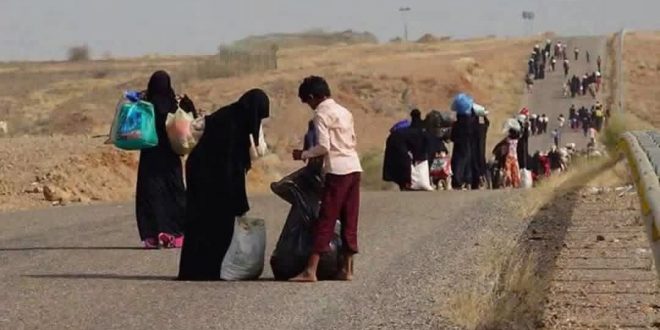
After years of relative calm across many of Yemen’s frontlines, renewed fighting has sent tens of thousands of people fleeing their homes.
Report: Abdulrahman Abotaleb
In a single week, from August 30 to September 5, 2026, the International Organization for Migration recorded 13,500 people displaced, most of them in Taiz governorate, with additional movements in Al Hodeidah and Lahj. Less than a week later, the United Nations reported that at least 46,000 people had been displaced since the latest escalation began.
For those fleeing, getting away from the fighting is the most immediate need. But reaching a safer place does not necessarily mark the end of war’s consequences. Forced displacement can coincide with the loss of work, income, land, assets and support networks that families depend on to secure food.
That raises a question that extends beyond the moment of flight: What happens to a family’s ability to obtain food after it is forced from home?
A study titled “From displacement to hunger: How migration due to conflict affects food security in Yemen,” by Sayed Jubair Bin Hossain, Niaz Makhdum and Maruf Hasan Rumi, published in PLOS One in October 2025, offers part of the answer. The researchers analyzed data from 13,891 people across Yemen’s 22 governorates using the 2022–2023 Yemen Multiple Indicator Cluster Survey.
They examined the relationship between conflict-related migration and two measures of food deprivation: how often people experienced hunger and how often they went an entire day without eating because they lacked money or other resources.
About 24% of participants reported experiencing hunger to some degree, while roughly 12% reported going a full day without food. After accounting for factors including age, sex, education, household size, wealth and place of residence, the researchers found that conflict-related migration was associated with a roughly 26% higher rate of reported hunger and a 25% higher rate of going an entire day without food.
Those figures do not mean displacement increases a person’s probability of hunger by 26 percentage points, nor do they prove that displacement itself caused the deprivation.
The study is observational. It does not follow the same people before and after they move, and its measures of food deprivation are based on participants’ reports rather than clinical assessments of malnutrition.
What it establishes is a statistical association between conflict-related movement and higher levels of certain forms of food deprivation.
That distinction is especially important now. The study cannot be used to predict that the tens of thousands displaced in recent weeks will experience the same outcomes. Its data were collected in 2022 and 2023 from a different population. But its findings provide a scientific lens through which to examine one of the risks families may face after being uprooted.
What is lost when people lose their place?
Food insecurity does not necessarily mean food has disappeared from the market. Food may be available while a family lacks the money or resources to obtain enough of it consistently.
That distinction is particularly relevant in Yemen. The Global Information and Early Warning System’s GIEWS Country Brief: The Republic of Yemen, published by the UN Food and Agriculture Organization, has documented persistent pressure on food security amid economic constraints, below-average domestic cereal production and heavy reliance on imported cereals.
A more recent GIEWS update reported that the Yemeni rial in government-controlled areas had depreciated by more than 30% against the US dollar year-on-year by June 2025, driving food and fuel prices to record highs and further weakening household purchasing power. In Hadramout market, wheat flour prices were about 40% higher in July 2025 than a year earlier.
This points to one of the central realities of Yemen’s food crisis: food can be present in the market and still remain beyond a family’s reach.
That is why losing a livelihood can matter as much as losing a home. For families dependent on farming, livestock, small businesses or casual labor, displacement can coincide with losing land, assets, employment, customers or social networks that once helped them withstand economic shocks.
But this pathway remains an important gap in the evidence. The PLOS One study does not track exactly what each person lost when they moved, and it cannot determine how much food deprivation can be attributed specifically to lost employment, land or income, rather than to higher prices, reduced assistance or other pressures.
The study itself provides another reason not to treat all forms of movement as equivalent. Simply moving from one Yemeni governorate to another was not consistently associated with higher food deprivation across the researchers’ models. Some associations became clearer when conflict was the reason for moving.
The question, then, is not simply whether someone moved. It is why they had to move — and what they lost along the way.
A food crisis bigger than displacement
Displacement is only one part of Yemen’s much wider food crisis.
According to the Integrated Food Security Phase Classification, or IPC, about 17.1 million people — 49% of the population covered by the analysis — faced Crisis-level or worse acute food insecurity between May and August 2025. The number was projected to rise to 18.1 million, or 52%, between September 2025 and February 2026.
The analysis does not attribute the crisis to conflict alone. Economic deterioration, shrinking income opportunities, climate shocks, displacement and declining humanitarian assistance all contribute.
The IPC also points to an important change over time. Conflict was the primary driver of food insecurity in 2022 and 2023, but as hostilities declined in the period that followed, economic pressures became increasingly prominent.
In other words, quieter frontlines do not automatically produce a quieter food crisis.
The consequences of years of conflict can persist through lost jobs, weakened purchasing power, higher prices and damaged livelihoods even when the immediate threat of fighting recedes.
When conflict strikes the food system itself
Other research supports the idea that war’s impact on food depends not only on whether violence occurs, but also on what it disrupts.
In “Impact of food-related conflicts on self-reported food insecurity,” Stefania Fiandrino, Caitriona Dowd, Giulia Martini, Yelena Mejova, Elisa Omodei, Daniela Paolotti and Michele Tizzani, compared different forms of conflict and self-reported food insecurity in Yemen, Syria and Burkina Faso. The study was published in Frontiers in Sustainable Food Systems in October 2023.
The researchers developed a measure designed to distinguish food-related conflict events from other forms of violence. Across the three countries, food-related conflict showed the strongest relationship with the share of people reporting insufficient food consumption among the conflict measures they tested. In Yemen, the regression coefficient for food-related conflict was substantially larger than those for total and non-food-related conflict events.
The study does not establish displacement as the mechanism behind that relationship. The authors also caution that their method of identifying food-related conflict may fail to capture all such events. But the findings highlight how conflict can affect food through what it disrupts across food systems.
A different perspective comes from “Civil Conflict, Cash Transfers, and Child Nutrition in Yemen,” by Olivier Ecker of the International Food Policy Research Institute, Afnan Al-Malk of Qatar University and Jean-François Maystadt. The study was published online in May 2024 and appeared in the July 2024 issue of the University of Chicago Press journal Economic Development and Cultural Change.
Using Yemeni data from 2012–2013 — before the current war — the researchers examined the relationship between conflict intensity and child nutrition, alongside the role of Yemen’s cash-transfer program.
Its findings should not be combined with the displacement study as though the two measure the same phenomenon. They cover different periods, populations, outcomes and research designs. Its relevance here is narrower: it adds evidence from another angle that the consequences of conflict for food and health can extend beyond the immediate casualties of fighting.
What happens after displacement?
The latest escalation brings that question back into focus at a time when Yemen’s food crisis remains severe.
In its latest Hunger Hotspots outlook, the Food and Agriculture Organization and the World Food Programme warned that Yemen was expected to continue facing severe levels of acute food insecurity between June and November 2026, amid economic, conflict-related and climate pressures as well as declining humanitarian assistance.
That is the environment into which tens of thousands of newly displaced people are now arriving.
The research cannot tell us what will happen to these families specifically, nor does it allow us to predict that they will experience hunger because they have been displaced. But it raises an urgent question that should not disappear once families move away from the fighting: What happens after they flee?
Science does not yet provide a complete answer. Among the available evidence, there is no study following the same Yemeni families before and after displacement while separately measuring the effects of lost employment, land, income, humanitarian assistance and rising prices on their access to food.
But the evidence is enough to challenge a simple assumption: that reaching a safer place means the consequences of war are over.
A journey of displacement may end at a camp, village or another city. Its economic consequences can last much longer.
Reaching a place away from the fighting does not automatically restore a job, land, income — or a reliable meal.
As tens of thousands of Yemenis begin another journey of displacement, the most important question may not only be where they are fleeing to, but how they will live and eat once they arrive.